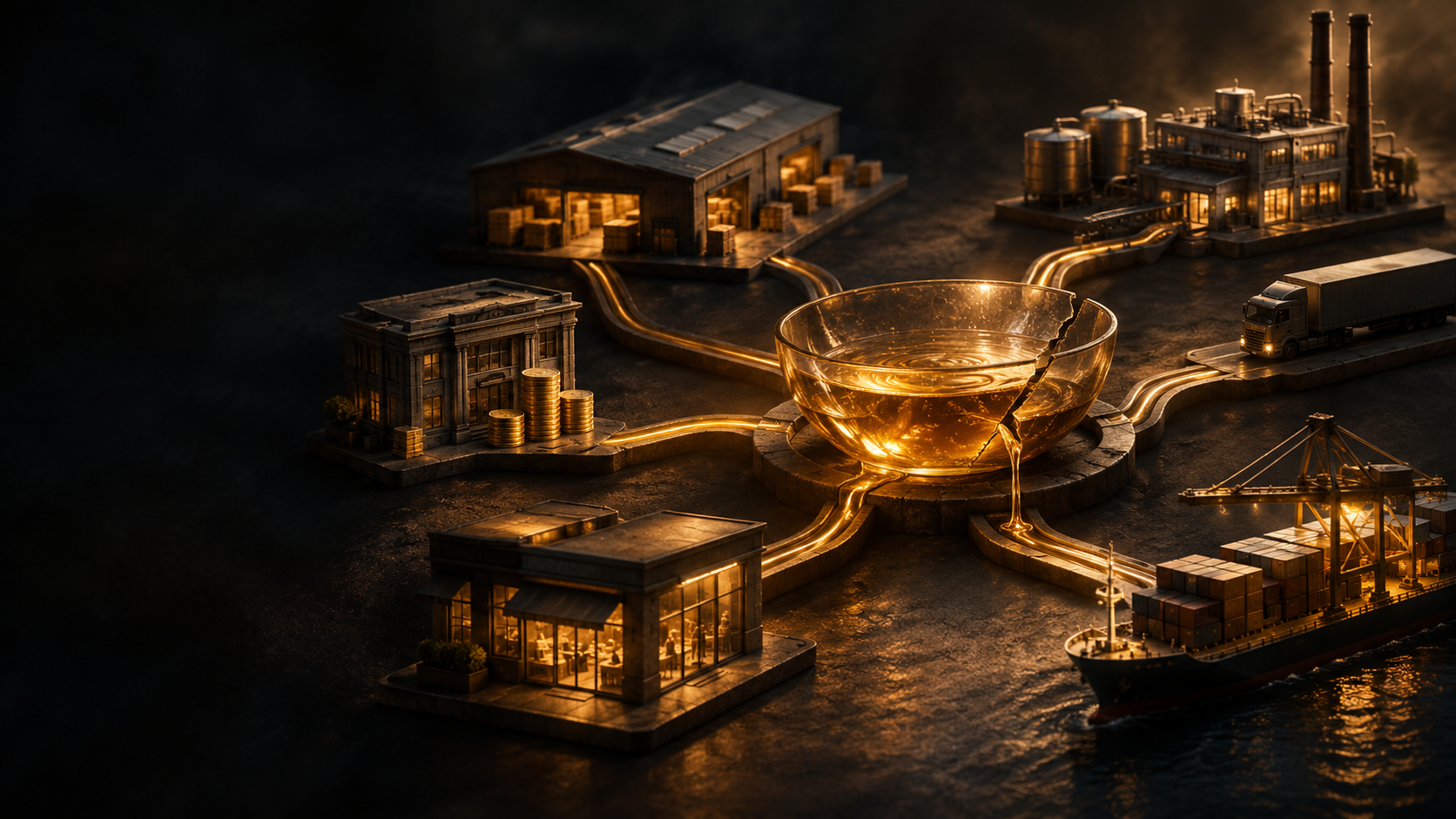
The Supply Chain Is a Network of Decisions
Markets coordinate strangers with prices. Inside a company, and between a company and its suppliers, that signal goes quiet, and sensible decisions start to collide. Superintelligence earns its place by pricing consequences, not by commanding from a tower.
Supply Chain | Editorial analysis*| Flames of Olympus Editorial |*Review draft, 11 November 2026
On 8 May 2001 Cisco Systems reported its results for the quarter that ended on 28 April. Sales were $4.73 billion, 4% below the same quarter a year earlier. The loss was $2.69 billion, and most of it came from one line: a charge of $2.25 billion for inventory the company no longer expected to sell.[1] Its chief executive, John Chambers, put the trouble down mainly to "macro-economic and capital spending issues".[1]
Two Stanford researchers, Erica Plambeck and Mor Armony, later read the episode differently. In a model built around it, customers who find one distributor out of stock place the same order with a second, then cancel the spare when the first is filled. A manufacturer that counts every order as demand overestimates the market and builds for customers who do not exist. Their conclusion was that the write-off "was caused by estimation errors".[2]
Nobody in that story behaved foolishly. Customers protected themselves against shortage. Distributors passed on what they were asked for. The manufacturer built what its order book showed. The loss lived in the connections between those decisions, and that is where a supply chain should be studied.
Reasonable people, distorted signal
Hau Lee, V. Padmanabhan and Seungjin Whang gave the pattern its academic form in 1997. Executives at Procter & Gamble had noticed that babies used Pampers at a steady rate while distributors' orders swung widely and P&G's own orders to suppliers swung more. The researchers traced such amplification to four causes: forecasts updated from orders instead of final sales, orders placed in batches, price promotions, and gaming when supply is rationed.[3][4]
Their uncomfortable point was that each cause is the product of "sound, rational economic decisions".[4] When Hewlett-Packard could not meet demand for its LaserJet III printer, resellers ordered more than they needed in order to secure an allocation. Once supply caught up they cancelled, and HP was left with excess stock and capacity that cost it millions of dollars.[4]
Better forecasting inside each company does not cure this. A perfect forecast of a distorted signal is still wrong.
Where the price signal goes quiet
Economics has a famous account of how strangers coordinate without a plan. Friedrich Hayek wrote in 1945 that when tin becomes scarce, its users do not need to know why: "All that the users of tin need to know is that some of the tin they used to consume is now more profitably employed elsewhere." Prices work, in his phrase, as "a system of telecommunications".[5]
Eight years earlier Ronald Coase had asked why, if prices are so capable, companies exist at all. His answer was that "there is a cost of using the price mechanism", so inside a firm an employee changes task not because a price moved "but because he is ordered to do so".[6] A company is a place where the market's signal is deliberately switched off and replaced by instruction, budgets and departmental targets.
That exchange has a price of its own. Take an invented manufacturer, used here only as an illustration. Purchasing wins a discount by doubling an order. Production enjoys a longer run. Sales offers generous payment terms to move the extra output. Each department reports a success, while finance watches cash leave earlier and return later. The discount was visible to the buyer who earned it. The cost of the capital tied up in the warehouse was not charged to that buyer, so it did not enter the decision.
The same silence falls between companies. A supplier sees its customer's order, not the sales behind it. The order is a decision, shaped by batching, promotions and fear of shortage, and it is a poor stand-in for demand.
A price for the consequence, not a tower
The usual technology proposal is a control tower: collect every data point and let one model decide. Hayek's objection to central planning applies inside the firm too. The knowledge that matters is local, changes daily and is often never written down. A single optimiser that is wrong is wrong everywhere at once.
A more modest use of superintelligence is to restore the missing signal. Before a decision is taken, the system estimates what it costs everyone else: the days of cash it consumes at the company's cost of capital, the capacity it displaces, the delivery promise it puts at risk. The buyer still decides, with the whole price in view. Disagreements between departments become visible as numbers that can be argued about.
This is an analytical proposal, not a description of a product in service. Such internal prices are estimates, and people who are measured on them will learn to game them. Some commitments, such as safety rules and signed contracts, should stay as limits that no price can buy. Someone must also own the decision about which commitments those are; otherwise a ranking produced by a model quietly becomes commercial policy that nobody approved.
What companies already worked out for themselves
The remedies recorded in 1997 were private arrangements between firms that both expected to gain. IBM, HP and Apple wrote into reseller contracts a requirement to report what was sold to end customers. Procter & Gamble managed the stock of its diapers at Wal-Mart. Continuous replenishment alliances were reported to bring inventory reductions of "up to 25 percent". Several manufacturers moved to stable everyday prices to stop customers buying ahead of promotions.[4]
Those are the authors' reports from the companies involved, not controlled experiments, and they do not prove what any one firm would gain. They do show the direction. The distortion fell where firms chose to exchange better information and to make over-ordering costly. The OECD reached a compatible conclusion in its 2025 review: "The key to supply chain resilience is not found in the elimination of risk, but in the effective navigation of risk."[7] Navigation is done by the firms that hold the risk, through contracts they are free to rewrite.
What changes when software places the orders
The next step is speculative. If purchasing software can place and cancel orders in seconds, the gaming that caught Hewlett-Packard becomes cheaper. A buyer's system could reserve scarce supply from five vendors and release four of them without a person noticing. Phantom demand would then travel at machine speed, and the supplier's forecast would degrade as fast as the buyer's improved.
The likely response is commercial. Suppliers can price commitment: deposits, cancellation fees, better terms for buyers whose orders have proved reliable. A firm's record of ordering what it then takes would become an asset with a market value. Information also shifts bargaining power. A supplier that sees its customer's sales knows how badly the customer needs the goods, which is one reason some buyers will refuse to share and will pay for that refusal in higher buffers.
Five questions before the next platform purchase
A reader responsible for a supply chain can test any proposal, human or machine, with five questions. Does the person who makes a decision see what it costs the rest of the business? Does a cancelled order cost the party that cancels it? Does the supplier see final sales, or only orders? Which commitments are limits, and who decided? Can the company still act on the day the coordinating system is unavailable?
Cisco's customers, distributors and planners each had an answer that made sense at their own desk. A supply chain is a network of such answers. It improves when each one carries the price of what it does to the others, and that is a job for contracts, prices and now superintelligence, working for the people who bear the risk.
Flames of Olympus Editorial
Flames of Olympus is an initiative of Platform Capital. We employ AI-assisted tools to support research, verify sources, check factual accuracy, identify inconsistencies, and strengthen editorial quality. Every article is evaluated against our editorial standards and must meet a defined quality threshold before publication. Articles that fall short undergo further revision or are rejected. AI supports our editorial process, but final responsibility for accuracy, analysis, and publication rests with human editors.
Unless otherwise indicated, this article presents independent analysis rather than original interviews or firsthand reporting. Its content should not be interpreted as legal, financial, investment, or other professional advice.
Sources and documentation
All links accessed on 11 November 2026.
[1] Cisco Systems. Cisco Systems Reports Third Quarter Earnings. Press release, 8 May 2001. https://newsroom.cisco.com/c/r/newsroom/en/us/a/y2001/m05/cisco-systems-reports-third-quarter-earnings.html
[2] Erica Plambeck and Mor Armony. The Impact of Duplicate Orders on Demand Estimation and Capacity Investment. Stanford Graduate School of Business Working Paper No. 1740, 2003. https://www.gsb.stanford.edu/faculty-research/working-papers/impact-duplicate-orders-demand-estimation-capacity-investment
[3] Hau L. Lee, V. Padmanabhan and Seungjin Whang. Information Distortion in a Supply Chain: The Bullwhip Effect. Management Science, vol. 43, no. 4, April 1997, pp. 546-558. https://pubsonline.informs.org/doi/abs/10.1287/mnsc.43.4.546
[4] Hau L. Lee, V. Padmanabhan and Seungjin Whang. The Bullwhip Effect in Supply Chains. Sloan Management Review, Spring 1997, pp. 93-102. https://sloanreview.mit.edu/article/the-bullwhip-effect-in-supply-chains
[5] Friedrich A. Hayek. The Use of Knowledge in Society. American Economic Review, vol. 35, no. 4, September 1945, pp. 519-530. https://www.econlib.org/library/Essays/hykKnw.html
[6] Ronald H. Coase. The Nature of the Firm. Economica, vol. 4, no. 16, November 1937, pp. 386-405. https://doi.org/10.1111/j.1468-0335.1937.tb00002.x
[7] OECD. OECD Supply Chain Resilience Review: Navigating Risks. June 2025. https://www.oecd.org/en/publications/2025/06/oecd-supply-chain-resilience-review_9930d256.html
Fact-check note
11 November 2026. Checked against the sources above: Cisco's sales, charge, loss, dates and the quotation from its chief executive [1]; the duplicate-order model and its conclusion about Cisco [2]; the four causes [3][4]; the Pampers and LaserJet III accounts, the contract, replenishment and pricing remedies and the 25 percent figure [4]; the Hayek and Coase quotations and publication details [5][6]; the OECD quotation [7]. The Management Science paper [3] was read in a university-hosted copy because the publisher's page did not load. The invented manufacturer and the section on software-placed orders are labelled as illustration and speculation.
This article does not necessarily reflect the views of Flames of Olympus.
 Ideas deserve to travel.
If this made you think differently, share it with someone who loves a good question.
Tell us the passage and, if you can, a source. A responsible editor will review the evidence.
Report an errorCorrections policy →