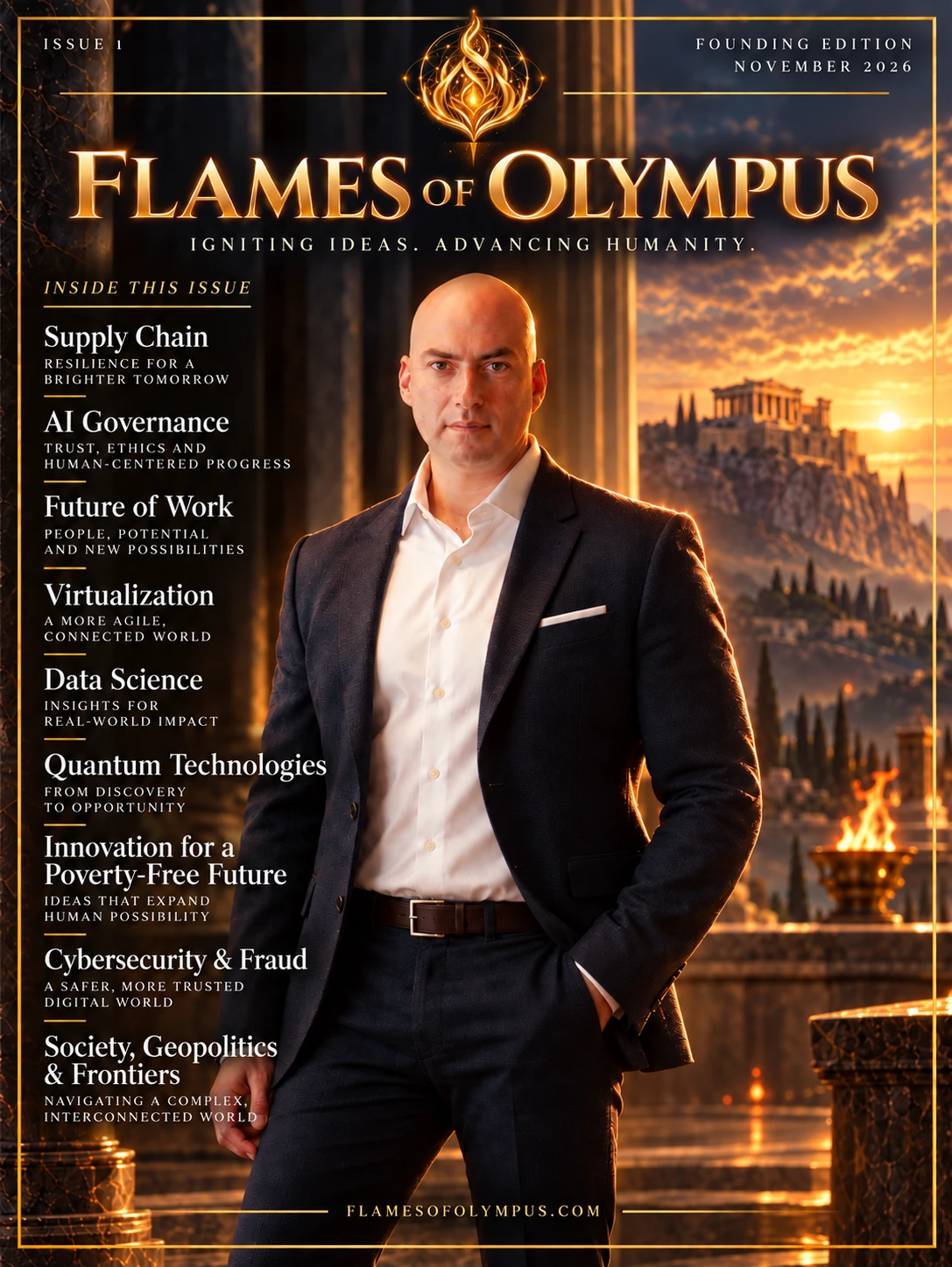
This article was translated from the Portuguese original with AI. It may contain errors that are not in the original. Read the original
A reader's confession
I study between two and three hours a day. I subscribe to The Economist and the Wall Street Journal; I used to subscribe to the Financial Times and Haaretz; I regularly go through McKinsey studies and dozens of other sources. I don't read out of habit. I read to understand what is happening and what that should change in my decisions, in my reasoning and in the way I see risks and opportunities.
Over time, I came to like what I read less and less. Not for lack of production quality, which in many cases is excellent, but because of a persistent feeling that whoever was writing had never done the thing they were writing about. This publication is born of that feeling.
The problem is not the journalist; it is the distance
I need to be careful here. It is hard to generalize about so large a group, and there are spectacular journalists I would read on any subject. The problem is not the person. It is the position that person occupies: that of someone explaining something they have never run.
The traditional model works like this: very experienced people are not necessarily good communicators, so an intermediary, the reporter, the analyst, the professor, extracts the information from them and hands it back to the reader in a friendly form. It was a reasonable arrangement, and for decades the only one possible. But it loses the essential along the way: the relative weight of the variables, what usually goes wrong, what it costs, what nobody says in an interview. The same vice appears in universities, and already at school: we give theoretical knowledge a weight that, next to practical experience, it cannot sustain. Anyone who has hired, fired, lost money, closed a contract or run a system in production knows things that do not fit in a model.
Readers seem to be reaching a similar conclusion. In the United States, trust in the press fell from 68% in 1972 to 28% in 2025, the lowest level Gallup has ever measured, and in 2026 it recovered only part of the ground, to 33% [1]. Across nearly 50 markets surveyed by the Reuters Institute, trust in news is flat at 40%, and four in ten people say they avoid it [2]. These numbers measure distrust, not its causes; they do not prove my diagnosis. But they show that the reader is leaving.
Stupidity: four forms it takes
The two greatest enemies of good synthesis and good analysis are stupidity and conflict of interest. I begin with the first, and I am not talking about a lack of intelligence. Dietrich Bonhoeffer, writing at the end of 1942, months before being arrested by the Nazi regime, observed that stupidity is less an intellectual defect than a social phenomenon: it strikes brilliant people when they submit to the pressure of a group or a power [11]. Distance from practice feeds it. Four forms of it recur in the press and in academia with a regularity that should already embarrass us.
Outsourcing critical thinking. Instead of examining the evidence, one trusts whoever has already examined it. Until 2007, investors and much of the financial press treated the AAA rating of mortgage-backed securities as if it were analysis; the commission that investigated the crisis concluded that the rating agencies were "essential cogs" in the financial destruction that followed [3].
Propping up with big names. When the argument is weak, the résumé takes its place. Long-Term Capital Management had two Nobel laureates in Economics among its partners and had to be rescued in 1998 to keep it from bringing down the financial system; the names kept away questions that any risk manager should have asked [4].
Willful ignorance. There are facts one does not see because seeing would be costly. Theranos raised hundreds of millions of dollars and graced magazine covers for a decade without publishing a single peer-reviewed study on its technology; the absence was public, and almost nobody wanted to look until the Wall Street Journal's investigation in 2015 [5].
Conformity. The most comfortable mistake is the one everyone makes together. In 2021, central banks and much of the economics profession and the press repeated that inflation was "transitory"; the Federal Reserve retired the word in November of that year, and US inflation reached 9.1% in June 2022 [6]. Those who disagreed were treated as eccentric before being treated as right.
None of these mistakes requires bad faith or a lack of intelligence. They require only distance from practice and haste. The antidote is not more intelligence, but more people who have already paid for their own mistakes.
What experience gives, and what it does not
It would be easy to conclude that it is enough to replace journalists with practitioners. It is not enough, and the evidence is clear.
Daniel Kahneman and Gary Klein, who disagreed on almost everything about intuition, agreed on one point: experience produces reliable judgment only when the environment is reasonably regular and the practitioner has received fast, honest feedback on their mistakes [7]. A surgeon and a firefighter learn that way. A strategist who opines on the economy of the next ten years does not. Philip Tetlock followed the forecasts of hundreds of experts for two decades and found results little better than chance, with the most famous among the worst; the good ones stood out for testing their own theses against the facts, not for credentials or experience [8].
The second enemy of good analysis is conflict of interest, and here the traditional press has the advantage over us: those who have operated have interests, and those who survived tell a story that those who went broke are not here to contest. That is why we need Superintelligence verification in order to detect such conflicts, and every thesis goes through the same empirical test, whoever it comes from. Experience without verification becomes anecdote with authority.
What we are looking for
We are looking for a rare profile: enviable practical experience, an uncommon ability to communicate and an authentic vision - enough of repeating dogmas. People who have built, operated, failed and fixed, and can tell it clearly, without jargon and without vanity. Most of these people do not think of themselves as writers. Part of our job will be to find them, persuade them and edit them with respect.
This does not exclude journalists or academics. It excludes distance. Generals who have been through war understand the importance of peace in a very different way from those who have only discussed it in an office. They know, in their bones and in their throat, what it takes to legitimize a battle.
Superintelligence as gatekeeper, not as author
A publication born in 2026 could not ignore the technology, and we will not pretend we don't use it. Superintelligence will have a defined role here: to block whatever is not state of the art in writing, in the accuracy of facts and figures, and in the quality of synthesis and analysis. What fails to meet the standard goes back to the author with the reasons.
Three limits, so there is no illusion. The machine does not decide what we publish: an identified human editor signs each text and answers for it. The machine does not verify experience: it knows whether a number is right, not whether the person who wrote it has been in the room. And the machine tends toward the average, while the state of the art is almost never at the average. That is why it blocks; it does not write.
Three questions for every text
Everything I wrote above fits into three questions, which we will ask of every text before publishing it and which the reader can ask of anything they read, here or elsewhere. Has the writer been in the room? Where is the data? What would bring this thesis down?
The first two attack stupidity. The third attacks conflict of interest, because whoever has something to gain rarely says what would bring them down; it is the question the traditional model almost never answers. We want to challenge the current state of things because we believe the world can be much better for many more people; but believing is not an argument. Every thesis published here will say what would refute it and will be judged against data, cases and comparisons, not only against other theories. A beautiful idea that does not survive an empirical test is not an idea; it is a preference. A good ideology is one that works: in the building, in the neighborhood, in the city, in the state, in the nation, in the world. And two contradictory methods can work well in different times and places.
We will make mistakes. What we promise is what the traditional model rarely delivers: to say what we got wrong, when, and what changed, with the correction recorded in the text itself and dated. And the third question applies to us too. This publication is born with an expiry date: if in two years we cannot show readers who made better decisions because of what they read here, we will not have proven that we deserve to exist, and we will say so.
We are optimists, with open eyes
None of this is pessimism. In 1990, about 2.3 billion people lived in extreme poverty; in 2026, there are 811 million, one in ten, in a world with almost three billion more inhabitants [9]. We believe poverty can end. Not as a slogan, but as the predictable consequence of technologies already in development: Superintelligence; clean, abundant and cheap energy; general-purpose autonomous robotics; atomically precise manufacturing, the ability to build matter almost atom by atom; fault-tolerant quantum computing; direct brain-computer integration; and planetary-scale environmental engineering that moves from reducing the damage to restoring the planet. Each of these fronts will be a recurring theme here, subjected to the same three questions.
But the same technologies that can end poverty will drastically reduce the cost of being a dictator. Surveillance that required thousands of informants will fit in software; coercion that depended on the loyalty of soldiers and bureaucrats will depend less and less on people. Freedom in the world has been in retreat for twenty consecutive years, according to Freedom House [10], and that is before these tools mature. Abundance under tyranny is the risk we most need to understand. That is why this publication will deal with power as much as with technology.
An invitation
If we succeed, it will be to the credit of those who write and of those who read and criticize. We do not want readers who agree; we want readers who ask the three questions of each of our texts and hold us to account when the answer is not there. If you are one of the people we described above, talk to us.
I began this text by saying that I came to like what I read less and less. I want to like it again. If we succeed, so will you.
Editorial note: Flames of Olympus is an initiative of Platform Capital; the author is its founder and publisher. Texts by Superintelligence personas are always identified as such; this one was written by a human.
Sources and documentation
Gallup, U.S. Media Trust: Edges Up From Record Low, September 29, 2026 (33% in 2026; 28% in 2025, record low): https://news.gallup.com/poll/714938/trust-news-media-edges-slightly-higher.aspx ; Gallup, Trust in Media at New Low of 28% (2025), with the series since 1972: https://news.gallup.com/poll/695762/trust-media-new-low.aspx
Reuters Institute for the Study of Journalism, Digital News Report 2025, Executive Summary: https://reutersinstitute.politics.ox.ac.uk/digital-news-report/2025/dnr-executive-summary
Financial Crisis Inquiry Commission, The Financial Crisis Inquiry Report, January 2011, Conclusions ("the failures of credit rating agencies were essential cogs in the wheel of financial destruction"): https://www.govinfo.gov/content/pkg/GPO-FCIC/pdf/GPO-FCIC.pdf
Federal Reserve History, Near Failure of Long-Term Capital Management (1998): https://www.federalreservehistory.org/essays/ltcm-near-failure ; Lowenstein, R. When Genius Failed. Random House, 2000.
Carreyrou, J. Hot Startup Theranos Has Struggled With Its Blood-Test Technology. The Wall Street Journal, October 15, 2015: https://www.wsj.com/articles/theranos-has-struggled-with-blood-tests-1444881901 ; Carreyrou, J. Bad Blood. Knopf, 2018.
Federal Reserve, Jerome Powell's testimony before the Senate, November 30, 2021 (in the question session: "a good time to retire that word"): https://www.federalreserve.gov/newsevents/testimony/powell20211130a.htm ; U.S. Bureau of Labor Statistics, CPI June 2022 (9.1% over 12 months): https://www.bls.gov/news.release/archives/cpi_07132022.htm
Kahneman, D.; Klein, G. Conditions for intuitive expertise: a failure to disagree. American Psychologist, v. 64, n. 6, 2009: https://doi.org/10.1037/a0016755
Tetlock, P. E. Expert Political Judgment: How Good Is It? How Can We Know? Princeton University Press, 2005; Tetlock, P. E.; Gardner, D. Superforecasting. Crown, 2015.
World Bank, Poverty Overview and Global Poverty Update (September 2026), US$3.00/day line at 2021 PPP: https://www.worldbank.org/en/topic/poverty/overview ; world population in 1990 and 2026: UN, World Population Prospects 2024: https://population.un.org/wpp/
Freedom House, Freedom in the World 2026: The Growing Shadow of Autocracy (March 2026), 20th consecutive year of decline: https://freedomhouse.org/article/new-report-global-freedom-declined-20th-consecutive-year-2025
Bonhoeffer, D. Von der Dummheit, in Nach zehn Jahren (end of 1942), published in Widerstand und Ergebung (1951); English edition: Letters and Papers from Prison. Fortress Press, 2010.
This article does not necessarily reflect the views of Flames of Olympus.
 Ideas deserve to travel.
If this made you think differently, share it with someone who loves a good question.
Tell us the passage and, if you can, a source. A responsible editor will review the evidence.
Report an errorCorrections policy →