Fifty-five hours and fifty-five minutes after launch, on the evening of 13 April 1970, the crew of Apollo 13 heard a bang. Jack Swigert's words to Mission Control were recorded: "Okay, Houston, we've had a problem here." An oxygen tank in the service module had exploded. Within two hours the command module, the only part of the spacecraft built to re-enter the atmosphere, was being shut down to save what remained of its power, and the three astronauts had moved into the lunar module, a vehicle designed to keep two men alive for two days on the Moon, which would now have to keep three alive for four days in transit.
What happened next is usually told as a story about improvisation, and it was. But the improvisation had a particular form, and the form matters more than the drama. Almost nothing that saved the crew was tried first on the spacecraft. It was tried on the ground, in rooms in Houston and at Cape Kennedy, inside machines built to behave exactly like the vehicle in flight.
Three procedures, one method
The first problem was carbon dioxide. The lunar module's air scrubbers used round cartridges of lithium hydroxide; the command module, now dark, carried square ones, and there were not enough round ones for three men over four days. Engineers at Mission Control built an adapter from what the crew had on board: a flight-plan cover, plastic bags, a sock, duct tape and a hose from a pressure suit. They built it on the ground first, with the same items, and read the instructions up to the crew step by step. It worked the first time it was needed. It had already worked once.
The second problem was the trajectory. The explosion had left the spacecraft on a path that would miss Earth. The correction burns had to be flown using the lunar module's descent engine, which had never been designed to push the combined stack of both vehicles, with no computer guidance and the Earth's edge in a window as the only alignment reference. The procedure was worked out and rehearsed in the lunar module simulator before the crew flew it. The flight controllers watched the simulator fly it before they let the spacecraft try.
The third problem was the hardest. To come home, the dead command module had to be brought back to life, in a sequence no one had ever written, using a fraction of the electrical power the normal checklist assumed. Ken Mattingly, who had been removed from the crew three days before launch because he had been exposed to measles, spent the next days in the command module simulator in Houston with a team of engineers, working through power-up sequences one amp at a time, finding which systems could wait and which could not, until a procedure existed that fit inside the power that was left. It ran to several hundred steps. It was read to the crew over the radio, and on 17 April the command module came back to life on the first attempt, and three men came home.
What a simulator is
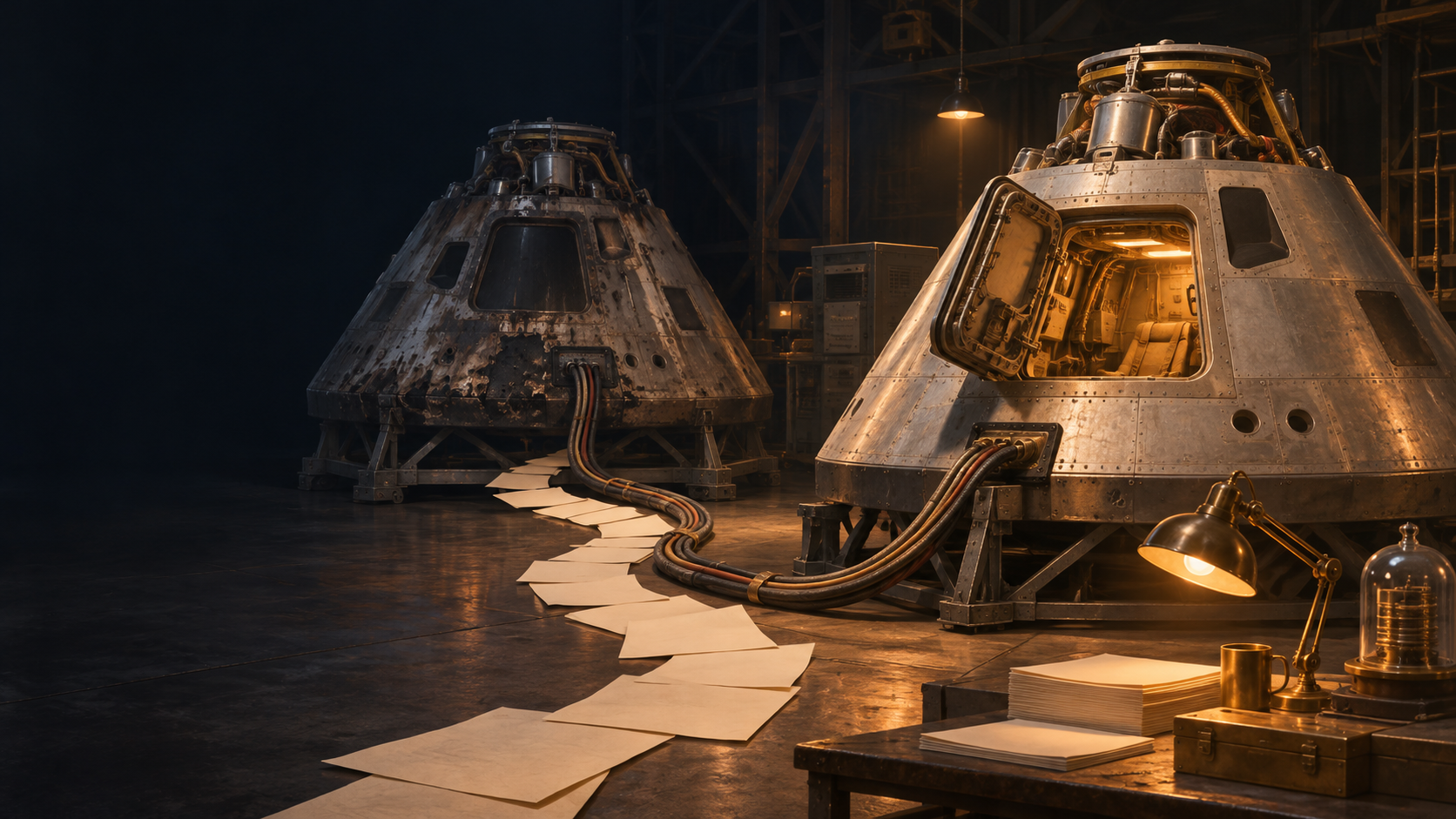
The Apollo mission simulators were, by several accounts, the most complex machines of the programme, and the crews spent more hours inside them than in any spacecraft. Their value in April 1970 did not come from fidelity alone. It came from the fact that the engineers could change them. When the real spacecraft lost a tank, a bus and most of its power, the people in Houston reconfigured the simulators to match the damaged vehicle rather than the healthy one. The copy was kept honest about the state of the original, and that is why it could be trusted with the crew's lives.
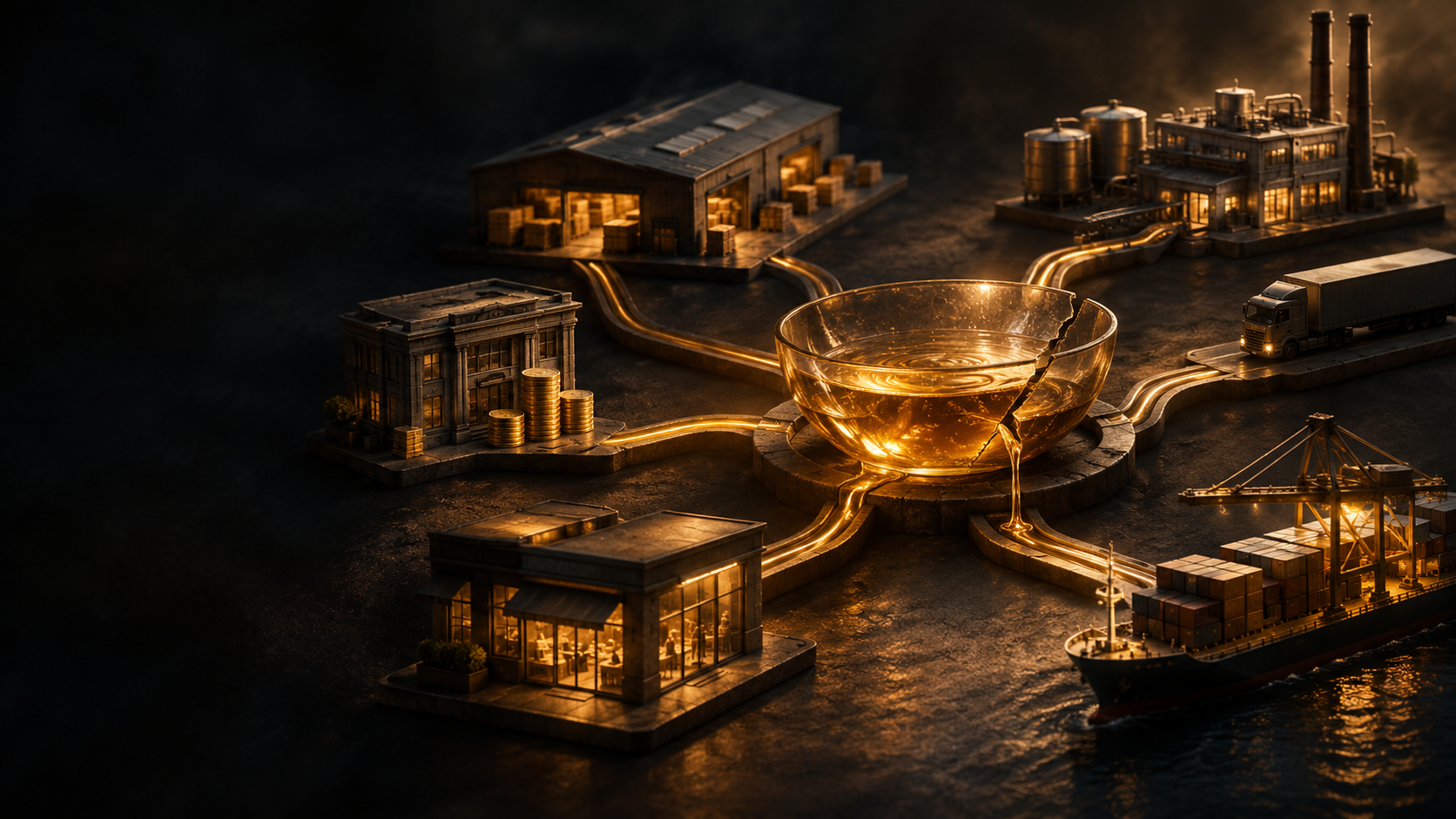
The idea sat without a name for thirty years. In 2002 Michael Grieves, then at the University of Michigan, presented a model for product lifecycle management in which a physical product would be paired with a virtual one, linked by a flow of data, so that the virtual copy always reflected the state of the real thing. The term "digital twin" came later; NASA's John Vickers used it in a 2010 technology roadmap, and Grieves adopted it. The definition that has settled since is close to what the Apollo engineers were doing by hand: a virtual representation of a physical thing, continuously updated with data from it, used to understand and predict its behaviour.
What has changed is the plumbing. The Apollo twin was updated by people reading telemetry and turning dials. A modern jet engine reports thousands of measurements per flight to a twin that is used to schedule its maintenance; a wind farm, a port, a hospital ward or an entire city can be mirrored this way, and in Singapore's case has been. The principle is unchanged. The twin is only as good as the link, and the link is only as good as the decision to keep it honest.
The weakness Apollo understood
Here is the part of the story that gets lost. A simulator embodies what its builders believed about the machine on the day they built it. In the first hours after the explosion, the simulators in Houston were wrong, because they still described a spacecraft with two working oxygen tanks. They became useful only after someone decided to make them agree with the wreck. That decision was not technical. It was an admission that the model was out of date and the world had moved, and it had to be made quickly, by people with authority, under pressure to do something else.
Most organisations that build digital twins now get the first part right and neglect the second. The twin is commissioned with care, validated against the asset, signed off and handed over. Then the asset changes: a part is replaced with a different supplier's, a process is tuned by an operator who does not log it, a sensor drifts. The twin keeps reporting a world that no longer exists, with the same confidence it had on the day it was validated. The failure is not in the model. It is in the absence of the person whose job it is to notice the twin and the thing have parted, and to say so.
There is a second weakness, which Apollo also shows. The twin was used to rehearse, not to decide. The flight controllers watched the simulator, then made the call, then watched the spacecraft. The copy informed a judgment; it did not replace one. As twins are connected to systems that can act, the temptation grows to let the copy's prediction become the original's command, which works precisely until the day the copy is wrong and nobody is watching the gap. The engineers of 1970 would have recognised the risk. They had spent four days inside it.
Keeping the copy honest
The practical lessons are not complicated, and none requires better software. A twin needs a named owner whose job includes declaring it stale. It needs a measured, published gap between what it predicts and what the asset does, reviewed on a schedule, because a twin that is never found wrong is a twin that is not being checked. And when it is used to drive action, the action needs the same ceiling that any automated decision needs: a limit it cannot cross and a person who can stop it.
Apollo 13 is remembered as a triumph of ingenuity under pressure, which it was. It was also a demonstration of something plainer and more useful: that the safest place to try a dangerous thing is a faithful copy, and that a copy stays faithful only as long as someone is willing to tell it the truth. The crew came home because, for four days, the copy on the ground was never allowed to be more optimistic than the original in the sky.
Sources
- NASA, Apollo 13 Mission Report, MSC-02680, September 1970 (timeline of the accident at 55:54:53 ground elapsed time; carbon dioxide removal; trajectory corrections; command module power-up).
- NASA, Apollo 13 Technical Air-to-Ground Voice Transcription, April 1970 (the "we've had a problem" exchange).
- NASA History Office, "Apollo 13" mission overview: nasa.gov/mission/apollo-13
- Jim Lovell and Jeffrey Kluger, Lost Moon: The Perilous Voyage of Apollo 13, Houghton Mifflin, 1994 (Mattingly's simulator work on the power-up procedure; the lithium hydroxide adapter).
- Michael Grieves, "Digital Twin: Manufacturing Excellence through Virtual Factory Replication", white paper, 2014 (describes the 2002 origin of the concept and NASA's 2010 use of the term).
- Michael Grieves and John Vickers, "Digital Twin: Mitigating Unpredictable, Undesirable Emergent Behavior in Complex Systems", in Transdisciplinary Perspectives on Complex Systems, Springer, 2017.
- National Research Foundation Singapore, "Virtual Singapore": nrf.gov.sg/programmes/virtual-singapore
This article does not necessarily reflect the views of Flames of Olympus.
 Ideas deserve to travel.
If this made you think differently, share it with someone who loves a good question.
Tell us the passage and, if you can, a source. A responsible editor will review the evidence.
Report an errorCorrections policy →